High-Flow Oxygen Therapy to Stop Cluster Headaches
Reviewed by the Clusterbusters Medical Board and Bill Mingus, a patient expert
On This Page
A complete plan helps you stop attacks and prevent new ones. See the options to discuss with your care team.
Oxygen is an essential tool for dealing with cluster headaches. For the majority of people with cluster headache, high-flow oxygen inhaled at the onset of an attack is the single most effective and consistently reliable abortive treatment available, often stopping an attack within 15 minutes or less. American and European headache treatment guidelines both list high-flow oxygen as the first-line abortive (acute) treatment for cluster headache.
Unlike many other prescribed abortive (acute) medications and treatments, oxygen has no negative side effects and can be used by most people (some exceptions include those with serious lung disease or similar conditions). And yet a major study found that 34% of people with cluster headaches in the U.S. have never tried it. Of those who do use it, half were never taught how to use it correctly.
This page covers everything you need to know: why it works, how to use it, how to get it, and what to do if it hasn't worked for you in the past. It includes a lot of detail. For a simplified summary, you can reference the guides created by ClusterInfo which were made in collaboration with Clusterbusters.
Key Takeaways
A landmark 2009 JAMA study found 78% of patients got significant relief within 15 minutes, yet many people have never been offered oxygen or were never taught to use it correctly.
The right equipment is essential: 15 lpm at minimum (many people need 25 lpm or higher), a non-rebreather mask (never a nasal cannula), and both home and portable tanks.
Breathing technique matters as much as equipment. Deep, rapid breathing with full exhales is what makes oxygen work.
If oxygen "didn't work" before, the cause is usually a flow rate too low, the wrong mask, or breathing technique, not oxygen itself. Please consult with us, your care team or our support groups before giving up.
Why 100% Oxygen Helps Cluster Headaches
78%
of participants experienced significant relief within 15 minutes (JAMA, 2009)
1st
line abortive treatment in American and European guidelines
34%
of people with cluster headaches in the U.S. have never tried it
The honest answer is that nobody knows exactly why high-flow 100% oxygen works as well as it does for cluster headaches. The first clues came in the 1930s, when researchers noticed that oxygen caused vasoconstriction, a narrowing of blood vessels, in the brain. During a cluster attack, these vessels vasodilate, or expand, which is thought to be why cluster headaches are so excruciating, as the trigeminal nerve can swell up to seven times its natural size during an attack. However, now it’s believed that introducing 100% oxygen decreases the activation of your parasympathetic nervous system.
What we do know is that it works. A landmark 2009 study published in the Journal of the American Medical Association found that 78% of participants, both episodic and chronic CH patients, experienced significant relief within 15 minutes using oxygen at 12 lpm (this is considered a low flow rate today). No side effects were reported.
The Right Oxygen Setup for Cluster Headache
Getting the right equipment matters a lot. Oxygen with the wrong mask or the wrong flow rate may not work and this leads many people to incorrectly conclude that oxygen doesn't work for them.
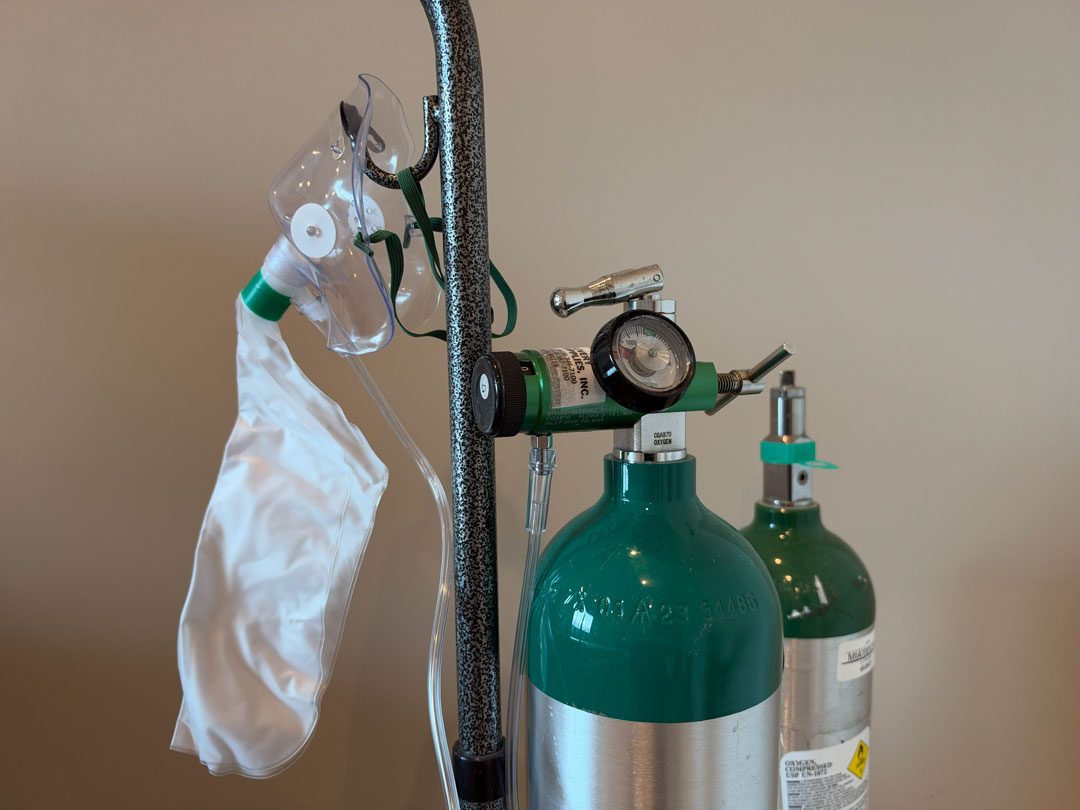
Oxygen flow rate
15 lpm minimum
More Details
The right flow rate is one that keeps up with your breathing. Here's a simple way to check: when you finish each breath, there should still be oxygen left in the reservoir bag. If the bag collapses or empties before you finish inhaling, your flow is too low, and you're likely pulling in room air instead of pure oxygen.
Many people need 25 lpm or higher, especially as attacks progress or if previous attempts at lower rates have failed. Increasingly, people with cluster headache are finding that higher flow rates, of 25 to 60 lpm, work best for them, ensuring that they always have enough oxygen coming through the system to inhale deeply. Depending on your lung capacity, you want to be able to breathe as deeply and quickly as you can. Some people, particularly smokers, may require even higher flow rates than non-smokers.
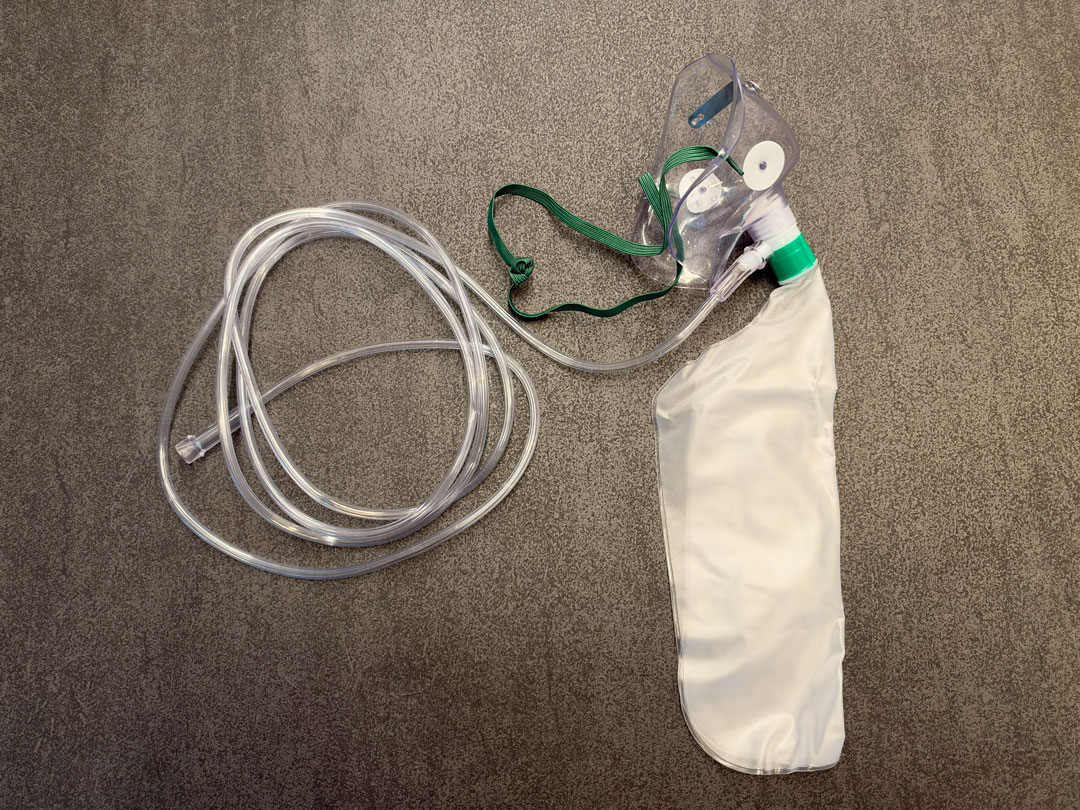
Mask
A non-rebreather mask is required. Not a nasal cannula.
More Details
- ClusterO2 Kit was designed specifically for cluster headache patients. It forms a tight seal, has a larger reservoir bag, has two one-way valves to direct flow during inhale and exhale, has two one-way valves to direct flow during inhale and exhale, and comes in multiple sizes. Many people report it cuts their abort time roughly in half compared to a standard mask.
- The standard mask your oxygen supplier provides likely has holes on the sides, as well as a poor seal around the mask that lets room air in and dilutes the concentration of oxygen for each inhalation. Cover those holes with tape.
A nasal cannula is useless for aborting attacks. You may use one to keep oxygen flowing for 15-20 minutes after an attack is aborted to elongate the pain-free time between attacks.
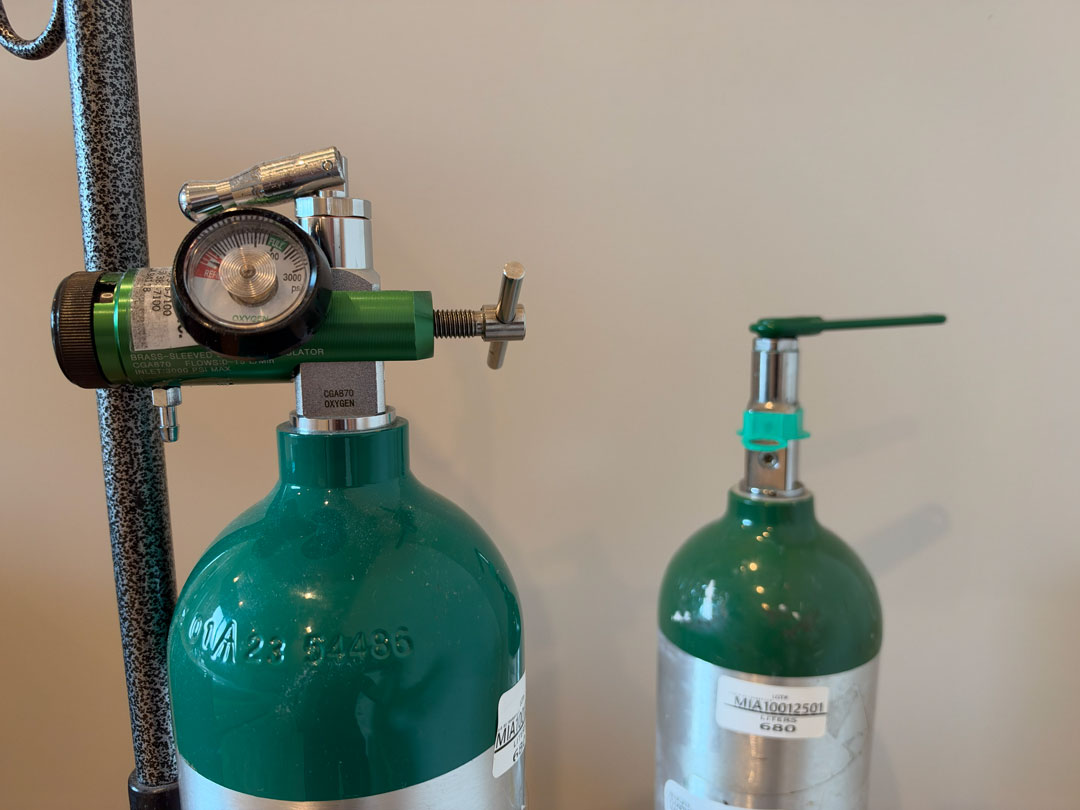
Oxygen tanks
Big tanks at home, small tanks everywhere else, multiples of both. Running out mid-attack is its own kind of misery.
More Details
- Larger tanks (for example “M” or “H”): An M tank can hold approximately 198 minutes of oxygen at 15 lpm and will be helpful for 9-12 attacks. H tank, sometimes called K, can hold roughly 460 minutes at 15 lpm. At 25 lpm, expect roughly half these numbers. Keep these at home, by the bed or couch.
- Smaller, portable tanks (for example “E”): can hold approximately 45 minutes at 15 lpm. Keep one or two at work or other locations you frequent. Bring them with you when you are out and about. “E” tanks may only last long enough to help with 3 attacks before running empty.
- It’s wise to keep a log containing the flow rate and number of sessions you are able to get from the first cylinder, and then calculate how long your supply should last. Capacities vary a little by manufacturer, so treat these as planning estimates rather than exact figures.
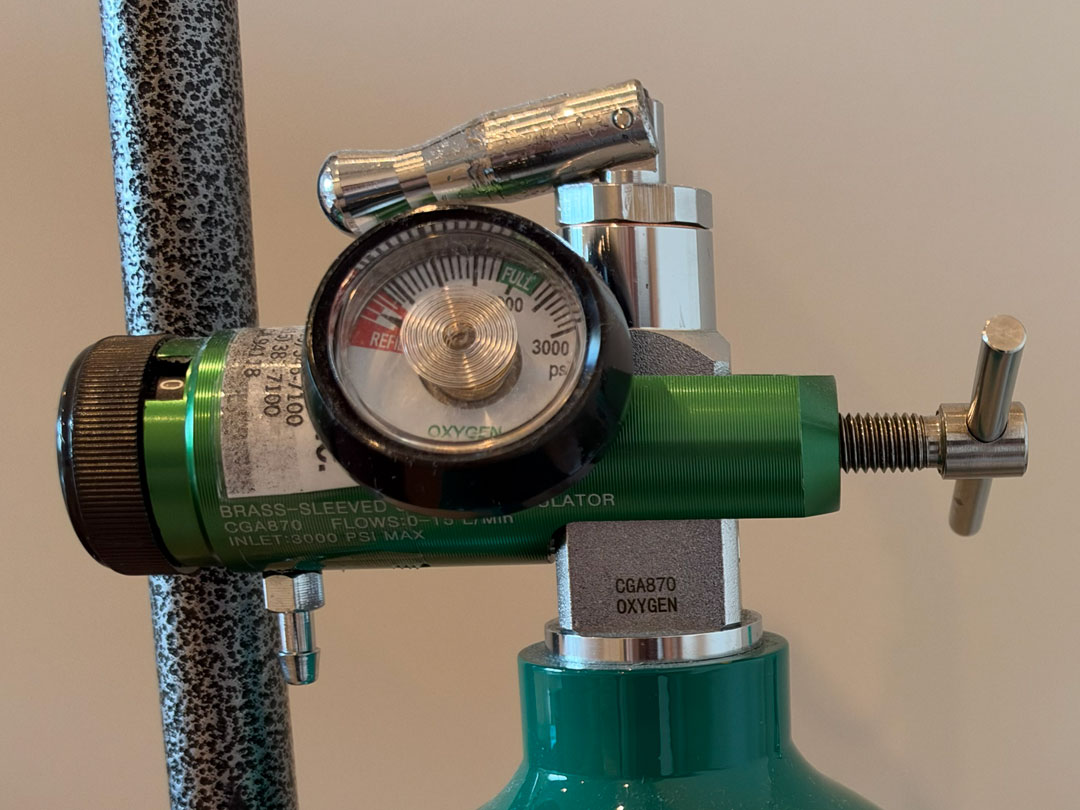
Regulator or demand valve
Match the regulator to your tank size. Demand valves are the upgrade if standard oxygen stopped working, or higher flow rates are required.
More Details
- Most people use a constant flow regulator. You will need one rated to 15 lpm orminimum, but try to buy for 25 lpm or higher (example). . Different tank sizes require different regulators, so do not order one until you know what tank you have.
- A demand valve is the alternative. Instead of pushing a steady stream into a reservoir bag, it delivers oxygen the moment you inhale. This is the upgrade to consider if your standard setup has stopped working well. It requires a DISS fitting. It can cost $350 or more, but is widely considered worth it by those who've made the switch.. Read about a clinical trial on cluster headache and demand valves.
Breathing strategy: Having the right equipment is only half of it. A specific breathing technique is necessary to abort an attack effectively. We cover this in depth in "How to Use Oxygen Correctly".
Safety Tips
Use great caution when storing or transporting tanks. They should be nowhere near open flames, nowhere they can fall or roll around and break off the valve or otherwise become damaged.
What not to buy
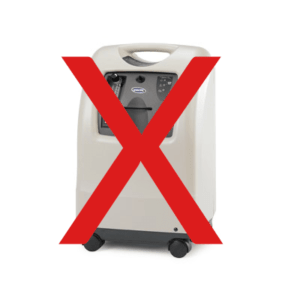
✕ Clusterbusters does not recommend welding oxygen. Medical oxygen prescribed by a physician and supplied by an approved vendor is always the preferred route.
✕ SCUBA tanks are never appropriate as they contain compressed air, not pure oxygen.
✕ An oxygen concentrator: these produce low flow and less than 100% pure oxygen. They are nearly useless for aborting cluster headache attacks.
✕ Any essential oils, supplements, or add-ons that aren't on this list.
Optional Upgrades: Longer Tubing, Humidifier, and Portable Systems
Longer tubing
25–50 foot extensions are available online and allow you to pace during treatment, which many people find helpful.
Humidifier / bubbler
Adds moisture to the oxygen stream to reduce dryness or irritation in the nose, mouth, and throat. Most people running 25 lpm or higher find bubblers do not work well at that flow (Check with your oxygen supplier before attaching a bubbler).
If you run lower flow and have dryness problems, here is what to look for. According to one publication, “a good rule of thumb is to look for a 3 to 6 psi rating with a ‘pop-off’ pressure relief valve, and a diffuser that generates smaller bubbles.” If you fill your own bubbler, be sure to use sterile distilled water. Tap water contains impurities such as calcium and iron that will eventually coat the inside of your tubing and your mask and may promote bacterial growth, which must be avoided.
Portable Oxygen System
There are backpack assemblies you can use at home and take to work. There are a few options to consider:
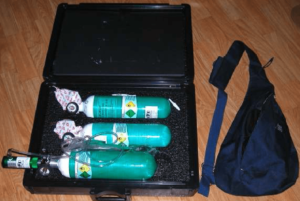
Integrated backpack oxygen delivery systems, like the unit shown below. There are also smaller portable oxygen kits with backpacks that clusterheads can use to gain even more mobility. The portable oxygen kit shown comes equipped with three 1-liter bottles of compressed oxygen charged to 3000 psi (200 BAR), a constant flow regulator, NRB mask, tubing, and the backpack. Depending on flow rate, each bottle holds 200 liters of oxygen that can be used to abort from one to three attacks.
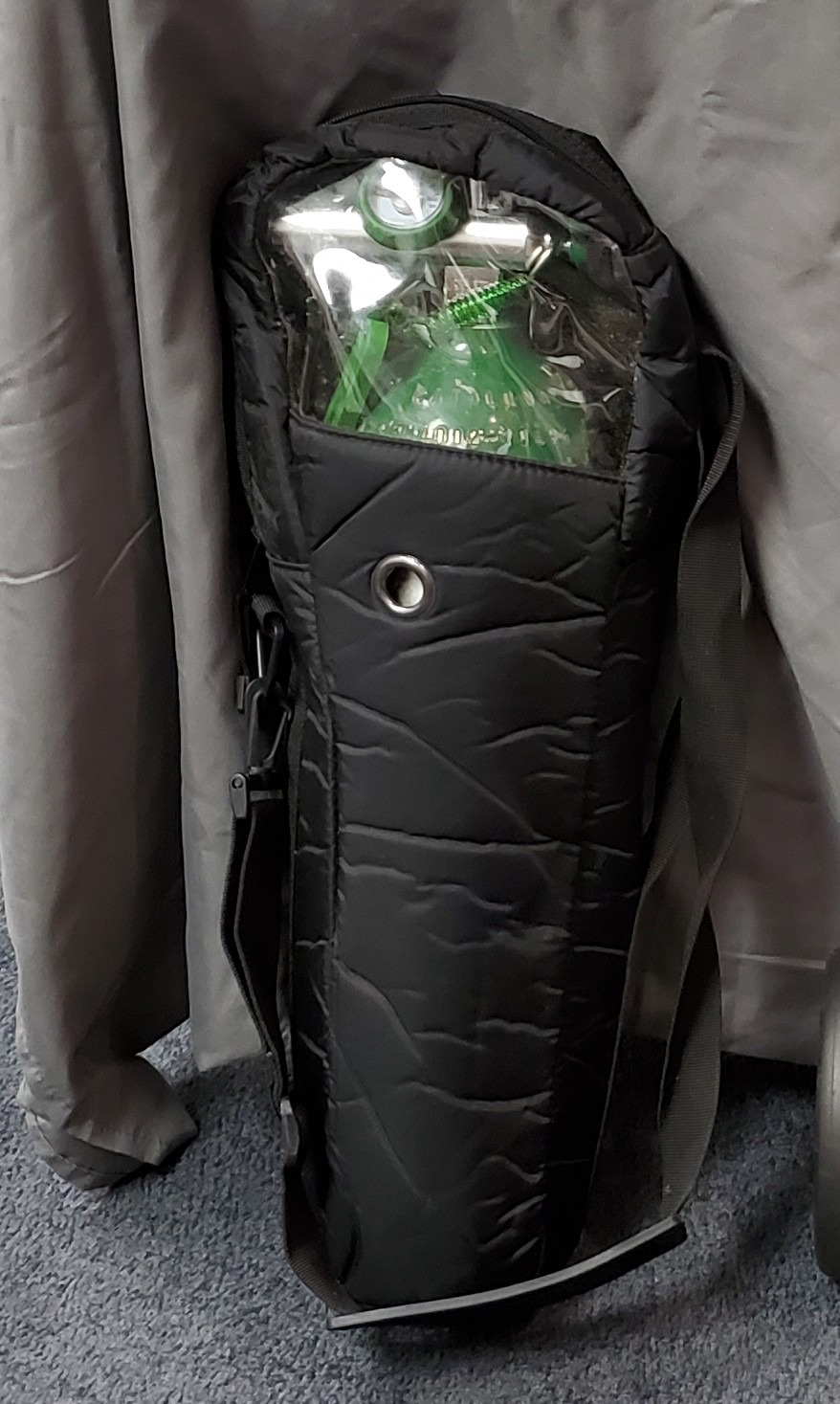
Another option is a D tank. Smaller tanks may run out and force someone to change tanks during a hit, which can be frustrating.
How to Use Oxygen Correctly
Having the right equipment is only half of it. Technique matters just as much. Like with everything else, you’ll need to experiment and find what works best for you via trial and error. This is what people in our community have found helpful.
Before you start: Safety
Don’t use the mask strap. Since some people fall asleep when an attack is aborted, you should consider not using a strap to hold the mask to your face. If you think you may fall asleep, cut off the strap and hold the mask firmly against your face with your hand. Recommend always cutting the strap off and covering mask holes.
Don’t smoke while using oxygen or around the tank when it’s not being used
Never breathe directly from the tank. The pressure is extreme and it is genuinely dangerous to your lungs. Always use a regulator and mask.
Timing
Start at the very first sign of an attack. DON’T WAIT. Use oxygen for up to 20 minutes per session. If the attack isn't fully aborted, wait 5–10 minutes and try again. After an attack ends, many people find it helpful to continue breathing oxygen for several more minutes, roughly as long as it took to abort the attack, to help delay or prevent a follow-on attack.
What success looks like
Most people who respond to oxygen abort within 15 minutes. If you are consistently going well past 15 minutes with no change, the problem is usually flow rate (out breathing the reservoir), mask, or technique rather than oxygen itself. See thetroubleshooting section before you give up on it.
Breathing technique
The goal is to get as much oxygen into your lungs as possible and clear out as much room air as possible. This means breathing more deeply and more rapidly than normal. For reference, a resting rate is 12 to 20 breath cycles per minute and you are aiming for roughly 24 to 30. Most people with cluster headache find it difficult to count their respiration cycles while they’re trying to abort an attack, so these numbers are more to give you an idea of the difference between “normal” respiration rates and how you might breathe in oxygen.
Whatever method you use, the fundamentals are the same: 100 percent oxygen, a properly sealed non-rebreather mask, and completely filling and emptying your lungs on every breath. A complete, forceful exhale is what most people get wrong.
Breathing techniques our community uses:
Slow Count
Inhale completely, hold for a self-defined count, then exhale completely while counting down. The count occupies the mind and this method uses the least oxygen of the three methods.
Accelerated Rhythm
Inhale completely and exhale completely with no pause in-between. Try a rate that seems slightly above normal. Some people find it helps to inhale through the nose, if not congested, and exhale fully through the mouth.
Hyperventilation
Do a complete inhale and exhale as fast as possible. This takes a lot of effort and uses the most oxygen but seems to produce results when other techniques have failed. At higher flow rates (25 lpm+) or with a demand valve system, a hyperventilation technique works well for many people. That is forcibly exhaling as much air as possible before each full inhale. Use caution with hyperventilation and find what works for you.
Techniques will vary from person to person and this list is not all inclusive but 100% O2, a proper mask and completely filling / emptying the lungs is key and will offer the best chance of success.
Troubleshooting: What to Do If Oxygen Hasn't Worked for You
Don't give up on oxygen yet. Most cases of "oxygen doesn't work for me" come down to one or more of the following:
Start earlier.
Oxygen works best when you start at the very first sign of an attack, before the pain builds. If you have been waiting to see whether an attack is going to be a bad one, that alone can be the reason oxygen seems ineffective. Once an attack is at full intensity, oxygen has a much harder time.
Raise your flow rate.
This is the most common fix.
- If your mask has a reservoir bag, you can only inhale as fast as that bag refills. Deep, rapid breathing empties it faster than 15 lpm can fill it, so you end up waiting between breaths, which is exactly what you cannot afford mid-attack.
- The sign: watch the reservoir bag while you breathe. If it collapses flat on inhale and does not refill before you need the next breath, your flow rate is too low for how you are breathing.
- Many people with cluster headache are finding that higher flow rates, of 25 lpm and higher, ensure that they do not have to wait between inhalations.
- Although we cannot recommend this, many people with 15 lpm regulators get good results from replacing the reservoir bag on their mask with an unscented garbage bag or turkey bag.
- With a demand valve system, you never have to wait for a reservoir bag to fill. Oxygen is immediately available as long as there is oxygen in your tank. A demand valve system requires a certain type of regulator, one with a DISS fitting that bypasses the lpm setting on the regulator, so you must be sure you have the correct parts, and a demand valve can be costly at $350 or more. However, many have benefitted from them when other systems have not worked to abort their attacks. Your oxygen supplier, or a person at a facility that sells demand valves, can help you obtain the right equipment. If you know a firefighter or paramedic, they may be able to help you procure oxygen demand valves.
Wrong mask or a poor seal.
A non-rebreather mask only works if room air cannot get in. Two things to check:
- The side holes. Most masks supplied by oxygen companies have vent holes on the sides that let room air in with every breath. Tape them shut.
- The fit around your face. If you feel air on your cheeks or around your nose when you inhale, or the mask shifts when you breathe hard, you are diluting your oxygen with room air. A mask designed for cluster headache, like the ClusterO2 Kit, seals more tightly and comes in multiple sizes. Cluster Headache Store
Breathing technique isn't moving enough air.
The goal is to get as much oxygen into your lungs as possible and clear out as much room air as possible.
- Be sure you are sitting up straight to allow your lungs to fill completely.
- Exhale completely and forcefully. A shallow exhale leaves room air in your lungs and there is nowhere for the oxygen to go. Most people focus on the inhale, but the exhale is what makes the difference. See breathing technique section for specific methods.
Before you rule out oxygen, try all together: start early, run a higher flow rate with a properly sealed mask, and breathe more aggressively than feels natural.
A helpful addition
Many people with cluster headache report faster results when they drink an energy drink containing caffeine and taurine, such as Red Bull, Monster, or 5-Hour Energy, at the very first sign of an attack, immediately before using oxygen.
If this doesn’t work or you need more guidance, please join one of our support groups and talk with fellow clusterheads.
How to Get an Oxygen Prescription for Cluster Headache
Your doctor should prescribe oxygen at the time of your cluster headache diagnosis. Many doctors don't, either because they're unfamiliar with cluster headaches or because they underestimate how effective oxygen is. You may need to advocate for yourself. That's frustrating, but it's common, and you can do it.
What to ask for:
Two or more large (for example "M") tanks for home use (or one large "H" tank at your home)
Two or more small (for example "E") tanks for travel and work
A regulator that goes up to at least 15 lpm (ask for 25 lpm if possible)
A cluster mask from the Cluster Headache Store. Remember to use the specific cluster mask - not the non-rebreather that may come with your tanks.
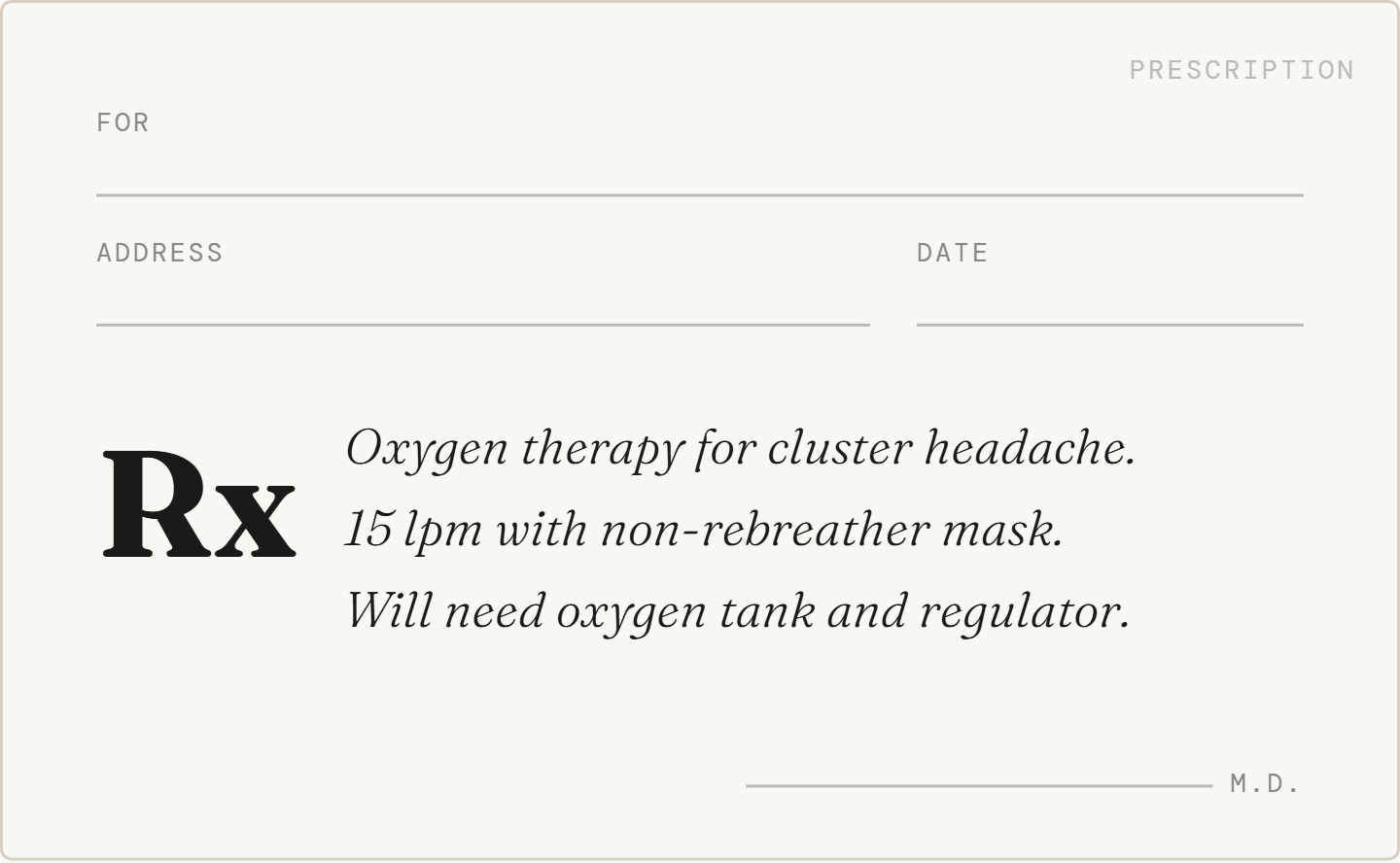
The prescription should read: "Oxygen therapy for cluster headache, as needed, at 15 lpm with a non-rebreather mask"
Beware
If the prescription you receive is for a low flow rate or does not specify a flow rate, a provider might give you a “concentrator” instead of a tank or tanks. A concentrator is a machine that creates oxygen out of room air. Concentrators are essentially useless for aborting cluster headaches, because they produce low flows and less than 100 percent pure oxygen, so be sure this is not what you are going to receive. (A very small number of people with CH do report that they can abort using a concentrator, but it is far from the best option.)
If needed, print and bring these studies to your appointment with the doctor you want to prescribe you oxygen:
JAMA, 2009
High-Flow Oxygen for Treatment of Cluster Headache
Inhale completely, hold for a self-defined count, then exhale completely while counting down. The count occupies the mind and this method uses the least oxygen of the three methods.
Cohen, Burns & Goadsby
Open study →
Headache, 2010
Inhaled Oxygen and Cluster Headache Sufferers in the United States
Inhale completely, hold for a self-defined count, then exhale completely while counting down. The count occupies the mind and this method uses the least oxygen of the three methods.
Rozen & Fishman
Open study →
On oxygen toxicity: Some doctors will cite oxygen toxicity as a concern. For cluster headache patients without pre-existing lung conditions, this is not a meaningful risk. Sessions are 15–20 minutes. There is no evidence that this duration causes harm.
If your doctor won't prescribe oxygen and can't give you a satisfactory reason - find a new doctor. This is a necessary treatment for people with cluster headache. Use our doctor directory to find a neurologist familiar with cluster headaches.
Working with Your Oxygen Supplier
Once you have your prescription, contact your oxygen supplier as soon as possible. Not all suppliers are familiar with cluster headaches, and some may default to giving you a concentrator or nasal cannula, neither of which will help you.
Be specific about what you need: tanks (not a concentrator) and a high-flow regulator. Some may provide a non-rebreather mask, but again, you should use a cluster mask from the Cluster Headache Store or similar. Ask them to walk you through setup and safety precautions before you need the equipment in an emergency.
If your prescription doesn't specify flow rate or tank size, your supplier may make decisions that don't serve you well. Follow up and confirm you're getting the right setup.
Ask about refill turnaround and whether you can keep multiple tanks at home. Some suppliers deliver, which is worth knowing before you are low mid-cycle.
Traveling with Oxygen
Traveling with oxygen takes planning, but is manageable.
By air
Air travel can trigger attacks for individuals with cluster headaches. Plane travelers generally can’t bring an oxygen tank with them into the cabin. Your best option is to ask for oxygen from the flight attendant. Airlines typically reserve oxygen for serious emergencies such as heart attacks or stroke, but there are workarounds. The pilot will need to approve your use. We have a separate guide on traveling with oxygen on a plane with specific steps and documentation you may need.
By train
Tanks can generally travel with you.
Out of town
Some suppliers will coordinate delivery to a destination. Ask about this in advance.
By car
Secure tanks so they do not become projectiles in the event of an accident. A small ratchet strap using the base of a seat to secure the tank will help prevent injury.
If you run out of oxygen unexpectedly, local fire stations or EMTs may be willing to help. The emergency room is another option, though staff there may be less familiar with appropriate oxygen therapy for cluster headache.
More Resources
Frequently Asked Questions
How quickly does oxygen stop a cluster headache?
For many people it aborts an attack within 15 minutes or less when used correctly at the first sign of an attack. Starting early and using a high enough flow rate makes a real difference.
What flow rate and mask do I need for cluster headache oxygen?
At least 15 lpm, though many people find 25 lpm or higher works best, paired with a non-rebreather mask. A nasal cannula and an oxygen concentrator will not abort attacks.
Why doesn't oxygen work for me?
Most often the flow rate is too low, the mask has a poor seal, or the breathing technique isn't moving enough air. Before ruling it out, try a higher flow rate with a proper mask and a more aggressive breathing technique.
How do I get an oxygen prescription for cluster headache?
Ask your doctor for a prescription specifying 100% oxygen for cluster headache, at least 15 lpm, a non-rebreather mask, and as-needed use, along with home and portable tanks. If a provider hesitates, our oxygen prescription guide and the 2009 JAMA study can help.
Can I fly or travel with oxygen?
It takes planning but is manageable. Airlines generally don't let you bring your own tank into the cabin, so the usual route is requesting onboard oxygen with the pilot's approval. Suppliers can often arrange tanks at your destination.
Not getting results?
Connect with experienced patients in our community.